 GMA
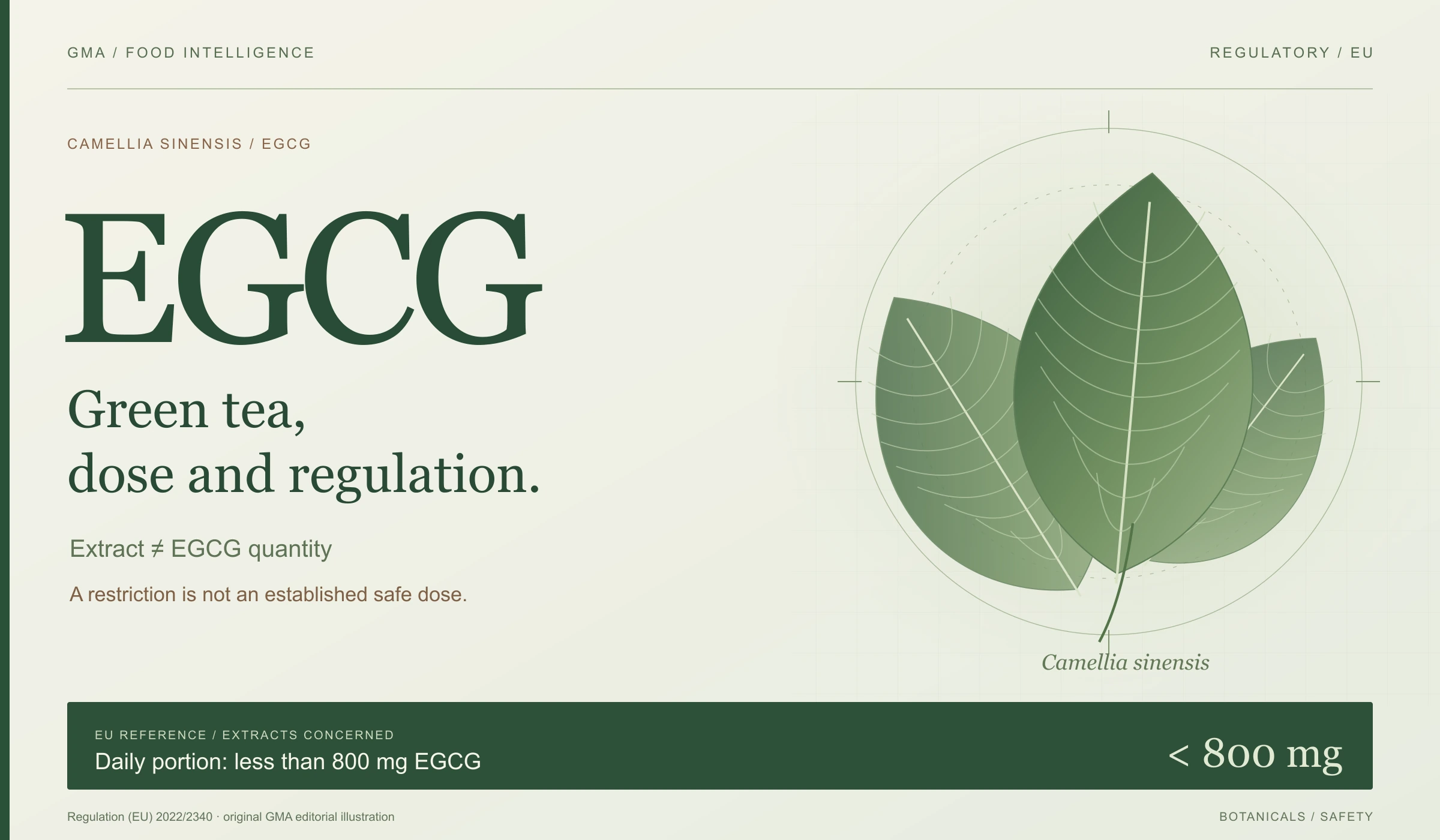
Extracts covered by the EU regulation must provide less than 800 mg of EGCG in the daily portion. This is not a guarantee of safety at lower intakes. EFSA’s additional-data mandate was closed in 2025; the statutory period for the European decision ends in December 2026, without an automatic ban.
Green tea extracts containing epigallocatechin gallate, or EGCG, are already subject to European restrictions. This catechin from the leaves of Camellia sinensis is distinct from caffeine. For supplement developers, the question is how to interpret the quantitative limit and follow a review approaching its statutory deadline, without turning a legal threshold into a guarantee of safety.
An existing restriction
The starting point is Regulation (EU) 2022/2340, in force since 21 December 2022. Green tea extracts containing EGCG were placed in both Part B of Annex III to Regulation 1925/2006, for restricted substances, and Part C, for substances under Union scrutiny. The daily portion must contain less than 800 mg of EGCG. Exactly 800 mg also fails to meet that condition.
One plant. Three frameworks to distinguish.
Choose a preparation to explore its framework. This map explains the distinctions; it does not classify a commercial product.
The daily portion must contain less than 800 mg of EGCG.
This is the framework under Regulation 2022/2340 for the preparations concerned. Meeting the quantity condition does not replace other requirements or establish safety. Warnings also apply at low intakes.
Read the source · 2022/2340 · art. 1150 mg of extract per portion; a warning not to exceed 300 mg per day.
Recital 17 preserves the authorised highly purified preparation, described as containing at least 90% EGCG. The novel food entry and all its specifications apply: a purity percentage alone does not identify an authorised ingredient. These quantities refer to extract.
Read the source · 2017/2470 · Union listA traditional cup is different from a concentrated capsule extract.
The specific entry excludes aqueous extracts that, after reconstitution in beverages, have a composition comparable to traditional infusions. This is not a blanket exclusion for all aqueous extracts or green tea drinks.
Read the source · 2022/2340 · Annex III footnoteThe liver safety signal
Liver safety explains the concern. In its opinion adopted in March 2018, EFSA found significant increases in transaminases, indicators of possible liver injury, in supplement trials using at least 800 mg of EGCG per day. The Authority could not, however, identify an intake without health concerns. Treating 800 mg as a dividing line between a “safe” and an “unsafe” zone would give the number a meaning that the opinion does not support.
How the extract is consumed also matters. EFSA reported that fasting and a single bolus dose can increase EGCG exposure compared with administration with food and in divided doses. Traditional infusions have a different composition and consumption pattern and were considered generally safe, without excluding rare individual reactions. The safety profile of a cup of tea cannot simply be transferred to a concentrated extract.
How much EGCG is in the extract?
A hypothetical example for extracts covered by Regulation 2022/2340. The percentage must refer to EGCG, not total polyphenols or total catechins.
A unit might be one capsule. Change the example; this is not a suggested dose.
500 mg × 40% × 2 = 400 mg
Below the 800 mg quantitative reference.
This does not establish safety or compliance. Preparation, conditions of use and all applicable requirements still need checking. The calculator does not assign novel food status, including at high purity percentages.
Formula, examples and accessible data
Daily EGCG = extract mg per unit × (EGCG % ÷ 100) × daily units. Comparison uses the unrounded value; the display retains up to twelve decimal places.
| Extract / unit | EGCG | Units / day | EGCG / day |
|---|---|---|---|
| 500 mg | 40% | 2 | 400 mg |
| 500 mg | 80% | 2 | 800 mg |
| 500 mg | 90% | 2 | 900 mg |
Warnings remain part of the requirement
Labelling must state EGCG content per portion, the maximum daily portions and a warning against consuming 800 mg or more per day. Warnings must also advise against use on an empty stomach, alongside other green tea products on the same day, during pregnancy or lactation and below the age of 18. The PAFF Committee on 9 February 2023, item M.01 clarified that the labelling requirements apply irrespective of the EGCG quantity. A low intake does not remove them.
The mandate closed in 2025
The subsequent process did not produce a new favourable opinion. In the EFSA minutes of 27–28 January 2025, the working group records that no data had been submitted during the designated period, which ended on 21 December 2024. Mandate EFSA-Q-2023-00420 was therefore considered closed. This documents the outcome of that data-submission process; it does not mean that no other EGCG research exists or that the earlier uncertainties have been resolved.
The deadline and the decision are different
Article 8(5) of Regulation 1925/2006 provides for a decision within four years of listing in Part C. For these extracts, the resulting statutory date is 21 December 2026. It is not the date of an automatic ban. At the check on 5 November 2026, no newly adopted general ban was identified in the official documents consulted. Any future change will need to be read for its scope and actual application dates.
Four steps, with different dates and statuses.
- 2018
- 2022
Restriction and scrutiny
In force: 21 December. The extracts concerned enter Parts B and C.
Original document - 2025
- 2026
Period for the decision
21 December, derived from Article 8(5). This is not an automatic ban.
Original document
GMA review: 5 November 2026. Source dates remain distinct from the date of this analysis.
Chronology and sources · CSVFrom the regulation to the ingredient specification
For a business, the useful first check is the identity of the material. Milligrams of extract and milligrams of EGCG are not interchangeable, and a total-polyphenol or total-catechin percentage cannot replace a specific EGCG assay. Conditions of use, labelling and evidence relevant to that preparation follow. A product assessment depends on maintaining those connections as the European dossier develops.
For ingredient developers and buyers, the preparation, its specific EGCG content and daily intake matter. Identifying the applicable framework comes before comparing a number with a threshold.
Document review as at 5 November 2026. No newly adopted general ban was identified in the official sources consulted. The teaching calculation neither assesses safety nor certifies a product’s compliance.
Editorial note. This content is intended for industry professionals. It does not constitute medical advice, therapeutic guidance or regulatory advice. Read our editorial method.
Read the original source · European Union · EFSA · primary documents