AI Lab · Applied case 03

From paper to dossier: analysing creatine with AI.

Week 40 · 2 October 2026

Three real studies. One evidence matrix. A dossier where each conclusion retains its source and its limitations.

Case 03 / Scientific evidence

Research, organised with AI.

A conclusion is useful when you can retrace it.

01 / Sources02 / Extraction03 / Review04 / Dossier
Open the dossier PDFTeaching corpus · 3 studies · 2026-10-02
3 studies → matrix → dossier
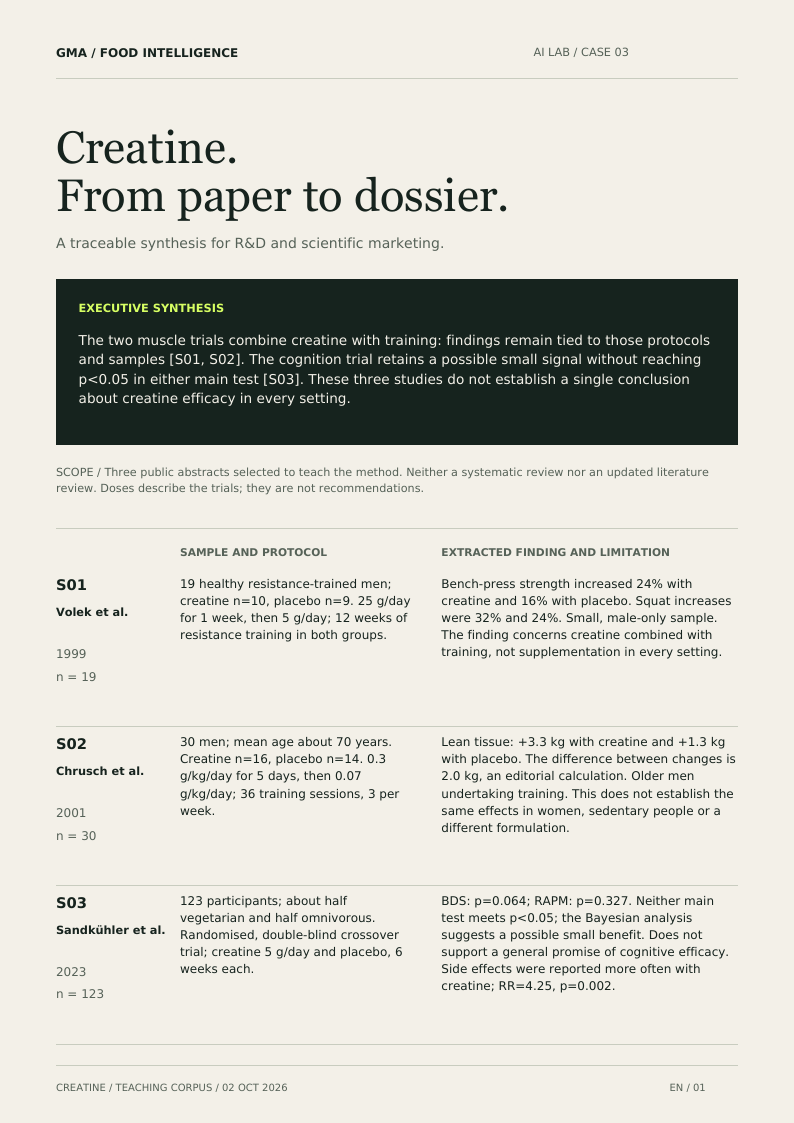
First page of the creatine dossier with synthesis, limitations and three evidence summariesPreview of the downloadable dossier · PDF / 01
01 / The brief

A useful question beats a hundred summaries.

What can we learn from these three creatine studies, and which conclusions change when the population, protocol and endpoint change?

The audience is an R&D or scientific marketing team. AI organises the supplied documents, aligns fields for comparison and prepares a preliminary synthesis for professional review.

  1. 01Identify the document and version
  2. 02Extract data with a reference
  3. 03Check comparisons and uncertainty
  4. 04Deliver a synthesis and open questions
02 / The studies

One ingredient. Different questions.

Open a study and follow the data to its source. These are editorial summaries assisted by AI; the references allow you to check them.

S01 · PMID 10449017

Performance and muscle fiber adaptations to creatine supplementation and heavy resistance training

Population
19 healthy resistance-trained men; creatine n=10, placebo n=9.
Protocol
25 g/day for 1 week, then 5 g/day; 12 weeks of resistance training in both groups.
Extracted finding
Bench-press strength increased 24% with creatine and 16% with placebo. Squat increases were 32% and 24%.
Transferability limit
Small, male-only sample. The finding concerns creatine combined with training, not supplementation in every setting.
Source trail: PubMed abstract · Methods / ResultsOpen the original abstract
Bench press: change from baseline

Within-group changes. The difference is 8 percentage points; this is not a 24% relative effect versus placebo. No confidence interval is shown here.

S02 · PMID 11740307

Creatine supplementation combined with resistance training in older men

Population
30 men; mean age about 70 years. Creatine n=16, placebo n=14.
Protocol
0.3 g/kg/day for 5 days, then 0.07 g/kg/day; 36 training sessions, 3 per week.
Extracted finding
Lean tissue: +3.3 kg with creatine and +1.3 kg with placebo. The difference between changes is 2.0 kg, an editorial calculation.
Transferability limit
Older men undertaking training. This does not establish the same effects in women, sedentary people or a different formulation.
Source trail: PubMed abstract · Methods / ResultsOpen the original abstract
Lean tissue: change from baseline

+3.3 kg is the change in the creatine group. The difference between changes is +2.0 kg. Lean tissue and muscle mass are not equivalent measures.

S03 · PMID 37968687

The effects of creatine supplementation on cognitive performance—a randomised controlled study

Population
123 participants; about half vegetarian and half omnivorous.
Protocol
Randomised, double-blind crossover trial; creatine 5 g/day and placebo, 6 weeks each.
Extracted finding
BDS: p=0.064; RAPM: p=0.327. Neither main test meets p<0.05; the Bayesian analysis suggests a possible small benefit.
Transferability limit
Does not support a general promise of cognitive efficacy. Side effects were reported more often with creatine; RR=4.25, p=0.002.
Source trail: Abstract · Results; full text · Results / DiscussionOpen the original abstract Read the full text Publisher PDF
Endpoint / S03

An uncertain result must remain uncertain.

Working memory / BDSp = 0.064
Reasoning / RAPMp = 0.327

Neither value is below 0.05. P-values do not measure the size of a benefit. They are therefore not displayed as efficacy bars.

03 / The matrix

One row per study. No invented average.

The two muscle trials and the cognition trial measure different outcomes. This matrix places them side by side without pooling results, scoring efficacy or treating them as a meta-analysis.

Comparative matrix of the teaching corpus: extraction from public abstracts
StudyPopulationProtocolExtracted findingTransferability limit
S01Volek et al.1999 · PMID 1044901719 healthy resistance-trained men; creatine n=10, placebo n=9.25 g/day for 1 week, then 5 g/day; 12 weeks of resistance training in both groups.Bench-press strength increased 24% with creatine and 16% with placebo. Squat increases were 32% and 24%.Small, male-only sample. The finding concerns creatine combined with training, not supplementation in every setting.
S02Chrusch et al.2001 · PMID 1174030730 men; mean age about 70 years. Creatine n=16, placebo n=14.0.3 g/kg/day for 5 days, then 0.07 g/kg/day; 36 training sessions, 3 per week.Lean tissue: +3.3 kg with creatine and +1.3 kg with placebo. The difference between changes is 2.0 kg, an editorial calculation.Older men undertaking training. This does not establish the same effects in women, sedentary people or a different formulation.
S03Sandkühler et al.2023 · PMID 37968687123 participants; about half vegetarian and half omnivorous.Randomised, double-blind crossover trial; creatine 5 g/day and placebo, 6 weeks each.BDS: p=0.064; RAPM: p=0.327. Neither main test meets p<0.05; the Bayesian analysis suggests a possible small benefit.Does not support a general promise of cognitive efficacy. Side effects were reported more often with creatine; RR=4.25, p=0.002.
Download the CSV matrix
04 / The review

The value appears when you correct the synthesis.

Two deliberately constructed errors show what review needs to catch. The initial sentences are simulations, not an experiment log or output attributed to a specific model.

Synthesis to correct · simulation / S02

Creatine adds 3.3 kg of muscle compared with placebo.

Corrected version / S02

In the trial of older men undertaking training, lean tissue increased 3.3 kg with creatine and 1.3 kg with placebo: a 2.0 kg difference between changes.

Review criterion: Correct the comparison, retain the population and use the name of the measured outcome.Open the original abstract
Synthesis to correct · simulation / S03

5 g per day significantly improves memory and reasoning.

Corrected version / S03

At 5 g/day for 6 weeks, neither main test meets p<0.05. A possible small effect appears in the Bayesian analysis and needs further investigation.

Review criterion: Separate statistical approaches and retain the uncertainty expressed by the authors.Open the original abstract

What makes it into the final dossier?

Retain

Findings, units, comparator, context and source.

Separate

Observed data, editorial calculations and interpretations.

Keep open

Product transferability, safety and regulatory assessment.

05 / The toolkit

Take the method into your next project.

Actual materials from this case, freely downloadable. The PDF combines the synthesis, evidence and checks; the CSV retains the fields; the prompt lets you repeat the process with other documents.

Read the complete prompt
ROLE
Act as a scientific extraction assistant for an R&D team. Prepare a preliminary ingredient dossier from the supplied documents only.

BRIEF
Ingredient: [name]. Question: [population, intervention, comparator, outcomes]. Corpus: [files or readable texts, version and date].

SOURCE CONTROL
Before analysis, list the documents actually read. Distinguish full text from abstract, inaccessible file and secondary source. Do not infer missing information or pretend to have read a PDF.

EXTRACTION
One row per study: ID, author/year, DOI/PMID/URL, document level, design, population, sample and groups, intervention, dose and unit, duration, comparator, endpoint, result, uncertainty, adverse events, limitations, exact source section/table/page. Use NOT REPORTED when a field is absent; use NOT VERIFIED when you cannot check it.

COMPARISON
Separate within-group change from between-group difference. Retain the original outcome name and units. Label any calculation explicitly, showing its inputs. Do not pool heterogeneous endpoints. Separate frequentist and Bayesian conclusions. Statistical significance does not establish clinical relevance.

DELIVERABLES
1. Comparative matrix. 2. Executive synthesis of at most 200 words with study IDs for every factual claim. 3. Data, interpretation and open questions in separate blocks. 4. Decision log: initial sentence, corrected sentence, reason and source. 5. Checklist for human review.

REVIEW
Recheck every number, population, comparator, DOI and locator against the supplied source. Keep uncertainty and negative findings. Do not produce dosing advice, product efficacy promises or regulatory authorisation. Record unresolved issues; do not invent a human reviewer or completed validation.

CASE CORPUS
S01: PMID 10449017 - public abstract.
S02: PMID 11740307 - public abstract.
S03: PMID 37968687 - public abstract; open-access full text available.
Historical teaching selection, not an exhaustive literature review.
Source ledger

Original documents and method notes

  1. S01
    Volek et al. · 1999

    Performance and muscle fiber adaptations to creatine supplementation and heavy resistance training

    DOI 10.1097/00005768-199908000-00011 · PMID 10449017
  2. S02
    Chrusch et al. · 2001

    Creatine supplementation combined with resistance training in older men

    DOI 10.1097/00005768-200112000-00021 · PMID 11740307
  3. S03
    Sandkühler et al. · 2023

    The effects of creatine supplementation on cognitive performance—a randomised controlled study

    DOI 10.1186/s12916-023-03146-5 · PMID 37968687

Editorial selection of three trials to illustrate the workflow; sources checked on 2 October 2026. The historical studies explain comparisons and do not, by themselves, represent the current state of evidence. AI assisted organisation and drafting: no measured time savings or performance claims are made. This case does not recommend doses, establish commercial claims or judge finished-product efficacy.

AI advisory

Need to make a dossier easier to read?

We start with your company’s documents and define an extraction, comparison and review workflow.

Tell us about your case
Permanent archive

AI Lab Weekly

Applied cases remain available as a growing library of workflows, outputs and controls.

Briefing & AI advisory

Receive the briefing.
Tell us about your work.

Choose editorial updates or request a free introductory discussion about a task you would like to automate. You can select both options in the form.

Selected newsFree consultationAI & automation
How can we help?