 GMA
Magnesium
and sleep.
The evidence starts
with the preparation.
The mineral’s name brings together very different products. Understanding the sleep evidence means returning to the preparation studied, the amount of magnesium and the way the outcome was measured.

01Different forms, doses and populations. These trials do not directly compare salts.
02In the 2025 bisglycinate trial, the mean difference on the ISI questionnaire is small.
03An authorised EU source and a demonstrated sleep benefit are separate questions.
One gram of what?
In the L-threonate trial published in 2024, the daily dose was one gram of the preparation. The elemental magnesium content was about 75 milligrams. In the 2025 bisglycinate trial, 1,786 milligrams of compound supplied 250 milligrams of magnesium. The larger numbers describe the material consumed; the smaller ones describe the mineral content. [1] [2]
This distinction changes how a technical specification should be read. The salt also includes what accompanies the magnesium: glycine in bisglycinate, threonate in L-threonate. The same mass of compound can therefore supply very different amounts of the element. Raw-material assay and daily dose need to be read together.
Sleep requires a further step. Plausible absorption, a role in nervous-system function or a higher magnesium concentration does not, by itself, demonstrate that someone falls asleep sooner or sleeps better. The clinical question concerns an outcome observed in people, against a comparator.
From compound to magnesium.
Select a preparation to read the dose in its trial. The bars show mass, not efficacy or absorption.
elemental magnesium
The paper also reports 1,523 mg of glycine in the bisglycinate preparation. The finding belongs to this preparation as a whole.
elemental magnesium
One gram of Magtein daily for 21 days. This is not one gram of magnesium.
elemental magnesium
Two tablets containing 414 mg MgO each: the paper reports 250 mg magnesium per tablet. 828 mg is the editorial sum of the two masses.
Doses reported in studies, not intake recommendations. The trials do not directly compare the forms.
A small difference, worth reading carefully.
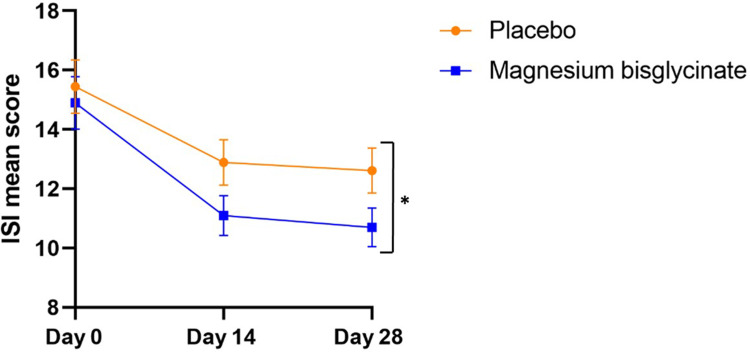
Schuster and colleagues randomised 155 adults aged 18–65 who reported poor sleep. For four weeks they received bisglycinate supplying 250 mg magnesium daily, or placebo. The primary analysis includes 153 people; 134 complete the study. [1]
The primary outcome was the Insomnia Severity Index, or ISI: a questionnaire about the perceived severity of sleep problems. Scores fall in both groups. The adjusted reduction is 3.9 points with bisglycinate and 2.3 with placebo. The mean between-group difference is therefore 1.6 points, with a small effect: Cohen’s d = 0.20 and p = 0.049.
The finding suggests a modest average benefit in this population over these four weeks. It cannot be converted into extra minutes of sleep. The other questionnaires show no significant group-by-time interaction; there is no objective sleep measure. The composition also includes the glycine in bisglycinate: the design does not isolate its contribution.
What changes on the ISI?

Adjusted estimates and 95% confidence intervals, Schuster et al. 2025, Table 3. A lower ISI score indicates lower perceived severity. The intervals for individual groups are not the test of the between-group difference.

Placebo minus bisglycinate: +1.6 points, 95% CI +0.0 to +3.3. The lower limit is rounded as in the source; p = 0.049. A positive value favours bisglycinate.
Read the chart values
| Estimate | ISI points | 95% CI |
|---|---|---|
| Bisglycinate change | −3.9 | −5.8 / −2.0 |
| Placebo change | −2.3 | −4.1 / −0.4 |
| Placebo minus bisglycinate | +1.6 | +0.0 / +3.3 |
The other trials change the question.
Placing results side by side cannot identify the “best” salt. Age, dose, duration and measurement tools differ across studies.
Some scores improve. Minutes tell a different story.
Eighty adults aged 35–55 are randomised to 1 g Magtein daily, about 75 mg magnesium, or placebo for 21 days; 76 enter the reported analyses. The ISI group-by-time interaction is not significant (p = 0.390). Some proprietary Oura scores, including deep sleep score and REM sleep score, are positive. There is no significant difference in total, deep or REM sleep minutes. These are different measures and need to retain their names. [2]
The 2025 corrigendum adds material information: retrospective registration after the study had been conducted, and complete statements about AIDP funding and three authors’ financial relationships with the company. These details belong in the assessment of the evidence. [3]
A selected group of older people.
Abbasi and colleagues study 46 adults aged 60–75 with primary insomnia; 43 complete eight weeks. The intervention supplies 500 mg elemental magnesium daily as oxide. Selection includes intake below 75% of the RDA and serum magnesium below 0.95 mmol/L: that threshold does not automatically mean clinical deficiency. [4]
Some indices, including ISI and sleep-onset latency, improve against placebo. Total sleep time shows no significant difference (p = 0.37). The sample is small, with its size calculated using renin, a hormonal marker, and multiple outcomes and no described multiplicity correction. Questionnaires and diaries do not become sleep-stage measurements because the study also includes hormone assays.
A cognitive primary outcome. A separate sleep question.
The trial published by Lopresti and Smith in January 2026 randomises 100 adults aged 18–45 who are dissatisfied with their sleep; 96 complete six weeks. The daily preparation is 2 g Magtein, supplying 145 mg elemental magnesium. The primary outcome concerns cognition. A positive cognitive result cannot establish a sleep benefit. [5]
In the full sample, the PROMIS Sleep-Related Impairment questionnaire, concerning daytime impairment related to sleep, shows a significant group-by-time interaction (p = 0.043). PROMIS Sleep Disturbance and the Restorative Sleep Questionnaire do not. No Oura sleep outcome shows a significant difference between groups; for total sleep time, p = 0.461. Positive exploratory subgroup findings should retain that status. The study has numerous outcomes, a young selected population and a six-week horizon.
Version check · 15 October 2026. The correction clarifies that all statistical tests were two-sided: the original description as one-tailed was a wording error. The reported results do not change. Read the correction.
Three tools, three ways of reading.
Before interpreting an improvement, establish what was counted.
Questionnaire
The ISI describes perceived severity of sleep problems. One scale point does not correspond to a fixed number of minutes.
Ring
A wearable estimates sleep using sensors and algorithms. A proprietary score can change without a significant increase in the estimated duration of a stage.
Polysomnography
Records physiological signals to classify sleep and wakefulness. Questionnaire or ring findings should not be presented as if they came from this examination.
The specification needs to meet the protocol.
For a development team, the first check is identity. Form, magnesium assay, daily dose, other components and specifications should make it possible to reconstruct what was administered. Writing only “magnesium” removes precisely the information needed to assess whether the evidence transfers.
The second check concerns the intended user. A small trial in older people selected for low intake does not answer the same question as a trial in younger adults reporting poor sleep. Duration matters too: three, four or six weeks do not describe continuous use over months or years.
Tolerability also matters. High supplemental amounts can cause diarrhoea, nausea and abdominal cramping. Reduced kidney function and some medicines require an individual assessment with a doctor or pharmacist. Raising the dose is not a shortcut to a greater benefit. [10]
Authorised source, safety, claim.
These are three separate checks in the European Union. Magnesium has authorised claims, under the applicable conditions, for contributing to normal nervous-system and psychological function and reducing tiredness and fatigue. In the register consulted on 24 October 2026, none of the authorised magnesium claims identified concerns sleep. Moving from “normal nervous-system function” to “improves sleep” would add a conclusion that the claim does not contain. [6]
For L-threonate, Regulation 2024/2694 authorises the novel food in adult supplements, excluding pregnancy and breastfeeding, with specifications and conditions of use. A corrigendum clarifies that the maximum level of 250 mg daily refers to magnesium, not 250 mg of compound. EFSA assessed up to 3 g of the preparation, supplying about 250 mg magnesium. Regulation 2025/2225 completes its inclusion among permitted supplement sources. None of these steps certifies a sleep benefit. [7] [8]
The European scientific tolerable upper intake level, or UL, of 250 mg daily concerns specified supplemental and added sources; it excludes magnesium naturally present in food. It is not a recommended sleep dose and does not, by itself, constitute a harmonised legal limit for every supplement. Conditions for the specific source and national rules in the intended market still need checking. [9]
Sources and method.
Targeted editorial research updated to 24 October 2026: four randomised trials selected for preparation, sleep outcomes and full-text availability; the 2025 and 15 October 2026 corrections were checked. This is not a systematic review or meta-analysis. No direct comparison between forms and no pooling of samples. GMA visualisations transcribe published aggregate data; these are not individual participant data.
Transparency. Schuster: university funding, Biogena product; one author declares industry activities and honoraria. Hausenblas: AIDP funding and financial relationships clarified in the corrigendum. Lopresti: Threotech funding and design input, with declared relationships to a nutraceutical CRO. Abbasi: NNFTRI/Shahid Beheshti University funding, no conflict declared. Details remain in the original publications.
- 01Schuster et al. · 2025Magnesium Bisglycinate Supplementation in Healthy Adults Reporting Poor Sleep.
- 02Hausenblas et al. · 2024Magnesium-L-threonate improves sleep quality and daytime functioning in adults with self-reported sleep problems: A randomized controlled trial.
- 03Hausenblas et al. · Corrigendum 2025Registration, funding and competing interests.
- 04Abbasi et al. · 2012The effect of magnesium supplementation on primary insomnia in elderly: A double-blind placebo-controlled clinical trial.
- 05Lopresti & Smith · 2026 + corrigendumThe effects of magnesium L-threonate (Magtein®) on cognitive performance and sleep quality in adults: a randomised, double-blind, placebo-controlled trial.
- 06European CommissionEU Register of health claims; Regulation 432/2012.
- 07EU · 2024/2694 + corrigendumNovel food: magnesium L-threonate; corrected maximum levels of Mg.
- 08EU · 2025/2225 / EFSA 2024Permitted magnesium source / safety and bioavailability assessment.
- 09EFSA / European CommissionUpper intake levels / food supplements framework.
- 10NIH Office of Dietary Supplements · 2026Magnesium: health professional fact sheet, safety and interactions.
Companion primary documents: Corrigendum · 15 October 2026 · EU corrigendum 2024/90741 · EFSA 2024 · e8656 · EU 432/2012 · European Commission · Food supplements.
An informational dossier for professionals. It proposes neither treatment nor a personal dose; the findings described are not finished-product claims.