 GMA
New Okinawa data link microbiome characteristics with cognitive performance and dietary diversity. The cross-sectional design cannot establish which factor comes first or demonstrate the efficacy of a nutritional intervention.
The name Okinawa carries an expectation: that its inhabitants’ habits or biology might reveal an explanation for longevity. The study published on 9 October in npj Dementia calls for a more patient reading. It observes microbiome characteristics and cognitive abilities together in an older population; it does not extract a recipe for healthier ageing from that snapshot.
The researchers examined 155 residents aged at least 65: 34 cognitively normal, 111 with mild cognitive impairment, or MCI, and 10 with dementia. Among the observed associations, Fusicatenibacter saccharivorans was linked to a cognitive-performance measure and dietary variety. Alpha-diversity differences between groups did not survive correction for multiple comparisons: “more diversity” cannot become the study’s general conclusion.
Which way does the relationship run?
A snapshot does not reveal the sequence of events. Diet may help shape the microbiome, while cognitive status and frailty may themselves change what someone eats. When this information is collected over the same period, distinguishing the possible directions requires care. The association begins the question rather than settling it.
Sample composition matters too. The dementia group contains ten people, a small share of the total that makes generalisation more fragile. The original figure is available in full within this article, including its scales and groups. Reading it alongside the denominators helps reveal what a headline about longevity might obscure.
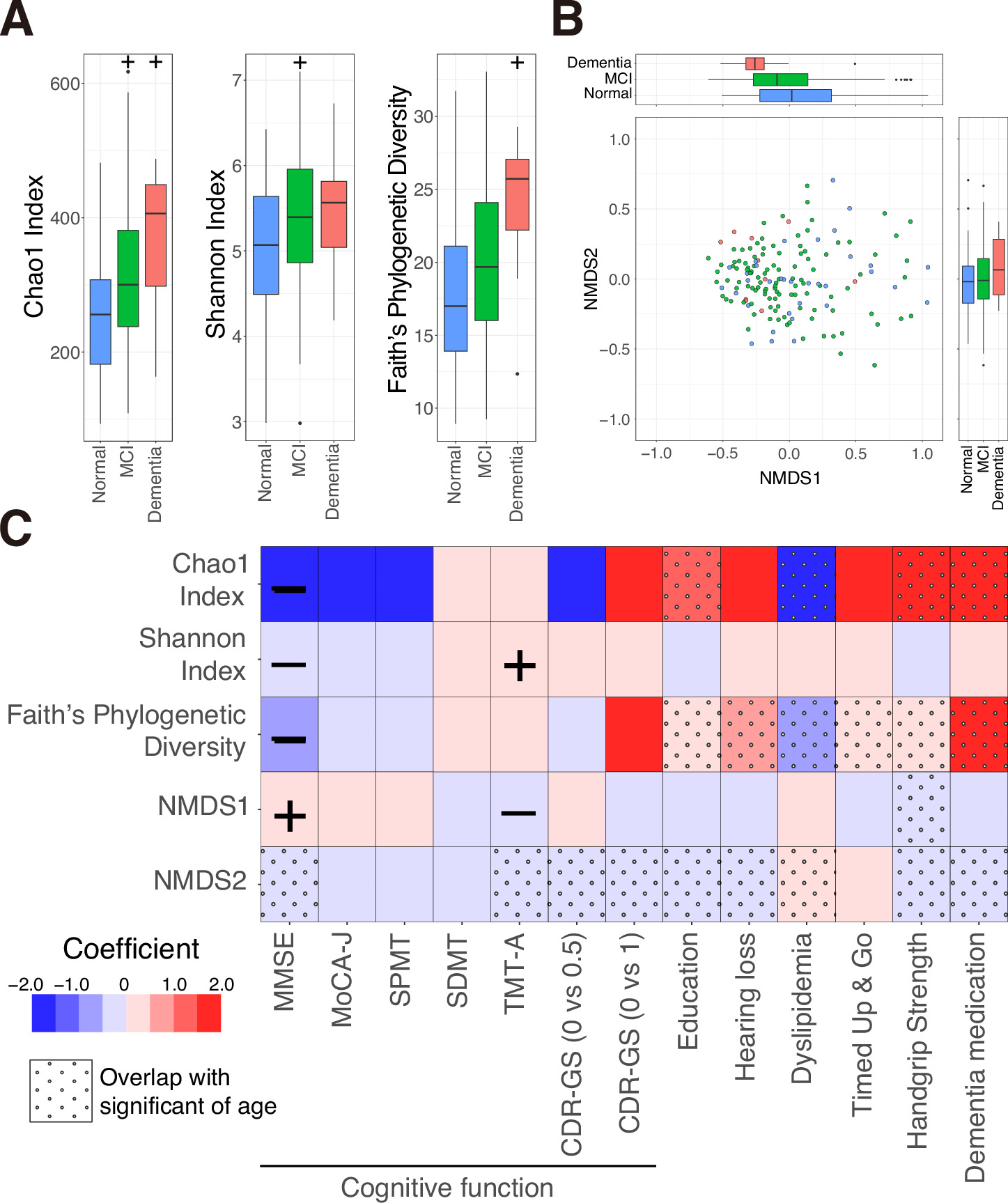
Associations in a cross-sectional study. The group differences in alpha diversity do not remain significant after multiple-comparison correction.
Shiroma et al. · npj Dementia (2026) · CC BY 4.0. Figure unchanged; WebP delivery. Open the complete figureFrom association to nutritional development
For teams working on the gut–brain axis, the value lies in the hypotheses the study makes more precise. Following people over time could test whether a microbial signature precedes cognitive change. A controlled intervention could then assess whether changing diet produces a measurable effect. Only those steps would support discussion of preventive usefulness or a benefit attributable to a preparation.
Funding includes JSPS, JST and Corundum System Biology; the authors declared no conflicts of interest. The work enriches research into a system of relationships without identifying a single bacterium to add to the diet or a product ready for cognitive prevention.
The research sharpens hypotheses about diet and the gut–brain axis. Turning them into ingredients or interventions requires longitudinal and experimental testing.
A local population, markedly uneven groups and possible confounding. Alpha-diversity differences do not remain significant after correction for multiple comparisons.
Editorial note. This content is intended for industry professionals. It does not constitute medical advice, therapeutic guidance or regulatory advice. Read our editorial method.
Read the original source · npj Dementia