 GMA
A plasma-metabolite score associated with Mediterranean-diet adherence is linked to lower all-cause mortality in PREDIMED and three US cohorts. The findings concern observational associations, rather than a supplement effect.
Diet also leaves traces in the blood. The scientific question is whether a combination of those traces can describe dietary patterns and associate with health outcomes beyond what questionnaires report. A paper published on 19 October in The American Journal of Clinical Nutrition examines a metabolic signature of Mediterranean-diet adherence and its relationship with mortality in four cohorts.
The previously identified signature combines 67 plasma metabolites. The analysis includes 1,880 PREDIMED participants, with 13.2 years of follow-up. Comparing the highest with the lowest tertile of the baseline metabolic score, the adjusted hazard ratio for all-cause mortality is 0.77, with a 95% confidence interval of 0.61–0.98. This describes a relative association over time, rather than a 23% absolute risk reduction or an individual prediction.
Replication with different comparisons
Replication in the US NHS I, NHS II and HPFS cohorts includes 12,704 people and 4,111 deaths over 25 years of follow-up. The hazard ratio for the highest versus lowest quintile is again 0.77, with an interval of 0.70–0.85. The similar estimate is of interest, but tertiles and quintiles define different comparisons. They are not perfectly matched measurements to be combined into evidence stronger than the study design allows.
PREDIMED began as a randomised trial, but this metabolite question is observational. The score is not a randomly assigned treatment: it can reflect diet, metabolism and other participant characteristics. Statistical adjustment and replication reduce some alternative explanations without removing all of them. The original figure reproduced below shows the relationship across the score, its uncertainty and the distribution of observed values.
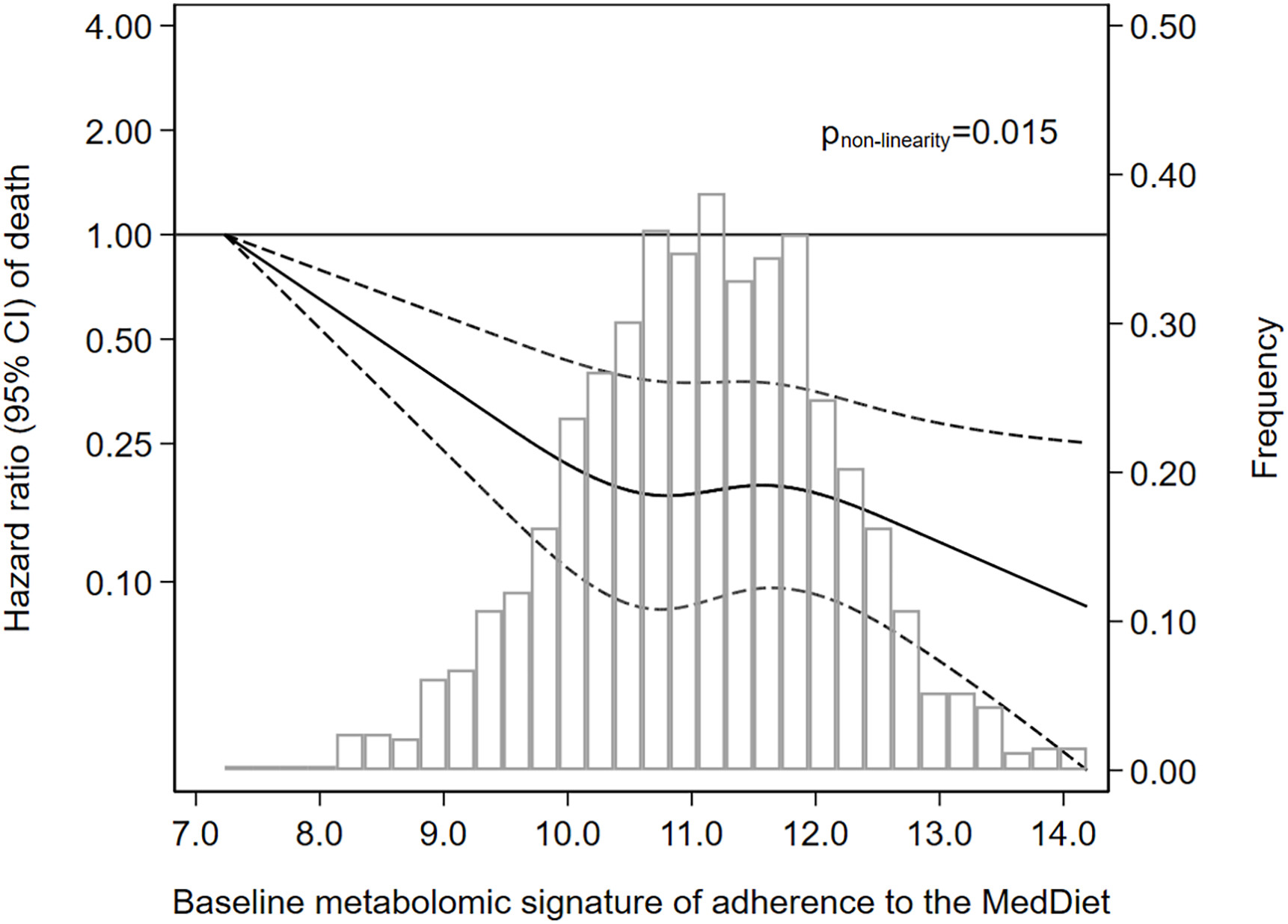
Observational associations, not the effect of a randomised supplement. Read the original figure with its full caption in the paper.
Toledo, Rovayo et al. · The American Journal of Clinical Nutrition (2026) · Fig. 2 · Original paper and full caption · CC BY 4.0. Complete figure, unchanged. Bars: score-value frequency; curve: hazard ratio on a logarithmic scale; dashed lines: 95% CI. Open at full resolutionFrom a biomarker to a possible use
For precision nutrition, the work’s contribution is to connect dietary measurement, biological signals and long-term outcomes. The next step asks a different question: whether measuring the signature helps select an intervention and improves a decision or outcome. Predicting or associating with an outcome does not establish that using the test provides benefit. That distinction also matters to businesses developing diet-related services or products.
The finding concerns a dietary pattern and a combination of metabolites. It does not isolate a single nutrient’s efficacy or justify transferring the association to a capsule or blend. Change in the signature during the first year was not significantly associated with mortality: the baseline finding does not establish that raising the score provides benefit. Generalisability, residual confounding and clinical utility remain unresolved. The work received NIH and public PREDIMED-programme funding; some authors report relationships with businesses and organisations in nuts, olive oil and food. The authors state that funders had no role in the analyses or publication.
Biological measurements can complement dietary questionnaires in nutrition research. Replication across populations helps assess a signal’s robustness but does not, by itself, establish individual clinical utility.
Observational analysis, including the sample drawn from PREDIMED. Residual confounding is possible and comparison groups differ across cohorts. The score is not established as a clinical test ready for use.
Editorial note. This content is intended for industry professionals. It does not constitute medical advice, therapeutic guidance or regulatory advice. Read our editorial method.
Read the original source · The American Journal of Clinical Nutrition